
The Tegel Matrix: How Berlin’s Schumacher Quartier Is Redefining Sustainable Urban Development
- Bauhuette 4.0
- Jul 16
- 3 min read

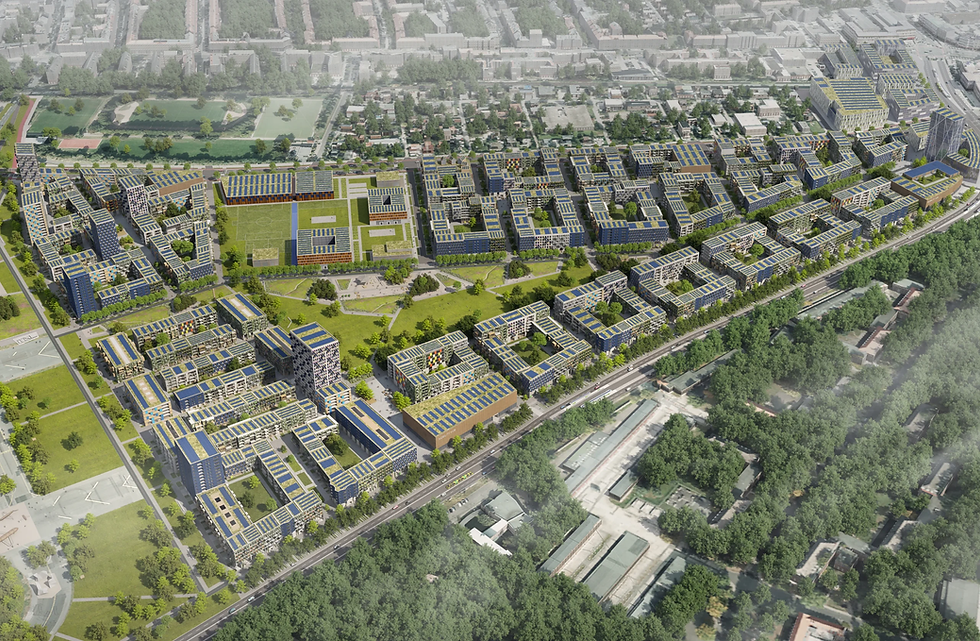
Plan for the Schumacher Quartier; ©Berlin TXL Management GmbH/ rendertaxi
The Tegel Matrix is the evaluation system driving sustainable procurement for Berlin's Schumacher Quartier, Europe's largest urban wood construction project. It assesses bids based on ecological and economic criteria to achieve 20–25% cost savings and 80% CO₂ reductions.
On the site of the former Berlin Tegel Airport, the Schumacher Quartier is being developed as a large-scale wooden construction district with over 5,000 apartments for more than 10000 future inhabitants. The project aims to reduce construction costs by 20–25% and cut CO₂ emissions by 80% compared to conventional building methods.
To achieve these goals, a sustainability evaluation system—referred to as the Tegel Matrix or Vergabematrix—was developed in collaboration with TU Berlin, Fraunhofer IPK, and Tegel Projekt GmbH. The matrix is used to assess construction bids based on ecological and economic criteria, ensuring that wood-based and circular construction principles are prioritized in the procurement process.
The Tegel Matrix evaluates bids across three main criteria, each with defined subcategories:
1. Construction
T1–T6 (Load-bearing structure): Material type (mineral, hybrid, wood, or renewable raw materials)
H1–H2 (Building envelope): Façade and insulation systems
A1–A4 (Interior fit-out): Flooring, walls, ceilings
2. Life Cycle Assessment (LCA)
CO₂ footprint (kg CO₂e/m²)
Renewable material content (kg/m²)
Carbon storage (kg C/m²)
Primary energy demand (MJ/m²)
3. Additional Criteria
Use of digital tools (BIM, LCA software)
Modularity and disassembly potential
Affordability and social impact
Each subcategory is assigned points based on predefined thresholds, with higher scores awarded to wood and bio-based materials. The total score determines the bid’s ranking.
There are certain challenges when it comes to urban timber construction, but there are also possible solutions. The Tegel Matrix aims to provide the latter. Traditional procurement processes often prioritize cost over sustainability, which can lead to short-term savings at the expense of long-term environmental and social costs, a lack of standardization in assessing ecological performance and difficulties for innovative wood-based solutions in competing with conventional materials.
The Tegel Matrix addresses these issues by creating equal opportunities for wood construction, which may have higher upfront costs but lower lifecycle expenses, simplifying LCA requirements for early project phases, and avoiding the limitations of earlier models, such as the Munich approach, which disproportionately benefited mass timber over hybrid or prefabricated systems. The lack of LCA expertise in early design phases is addressed through a simplified matrix with predefined thresholds. Resistance to change is countered with pilot projects and showcases, while new funding instruments tied to LCA/LCC performance provide policy support. Supply chain bottlenecks are resolved through regional networks that mobilize capacity.
From Berlin to the world - what might be the lessons for other cities?
The Tegel Matrix provides practical insights for cities working to decarbonize construction. Cities can prioritize ecological criteria in procurement rather than focusing solely on cost. Furthermore, standardizing sustainability metrics enables actually fair comparisons between bids. Investing in digital tools such as BIM and LCA can streamline decision-making and fostering collaboration between forestry, industry, and urban planners ensures a cohesive approach. Creating pilot projects serving as real-time laboratories helps demonstrate feasibility and builds public and industry confidence.
What's next?
The Schumacher Quartier is expected to be completed in phases, with the first residents moving into carbon-negative, affordable homes built with locally sourced wood, digital precision, and circular economy principles. We are looking forward to it!
Comments